The Silent Concert Hall: Granger Music Hall, National City
⌖ National City, California
The story in brief
A small redwood concert hall where some of the world's great violinists once played sits boarded up behind a fence on East 4th Street. It is one of the rarest surviving works of architect Irving J. Gill, and it has been silent since 2008.
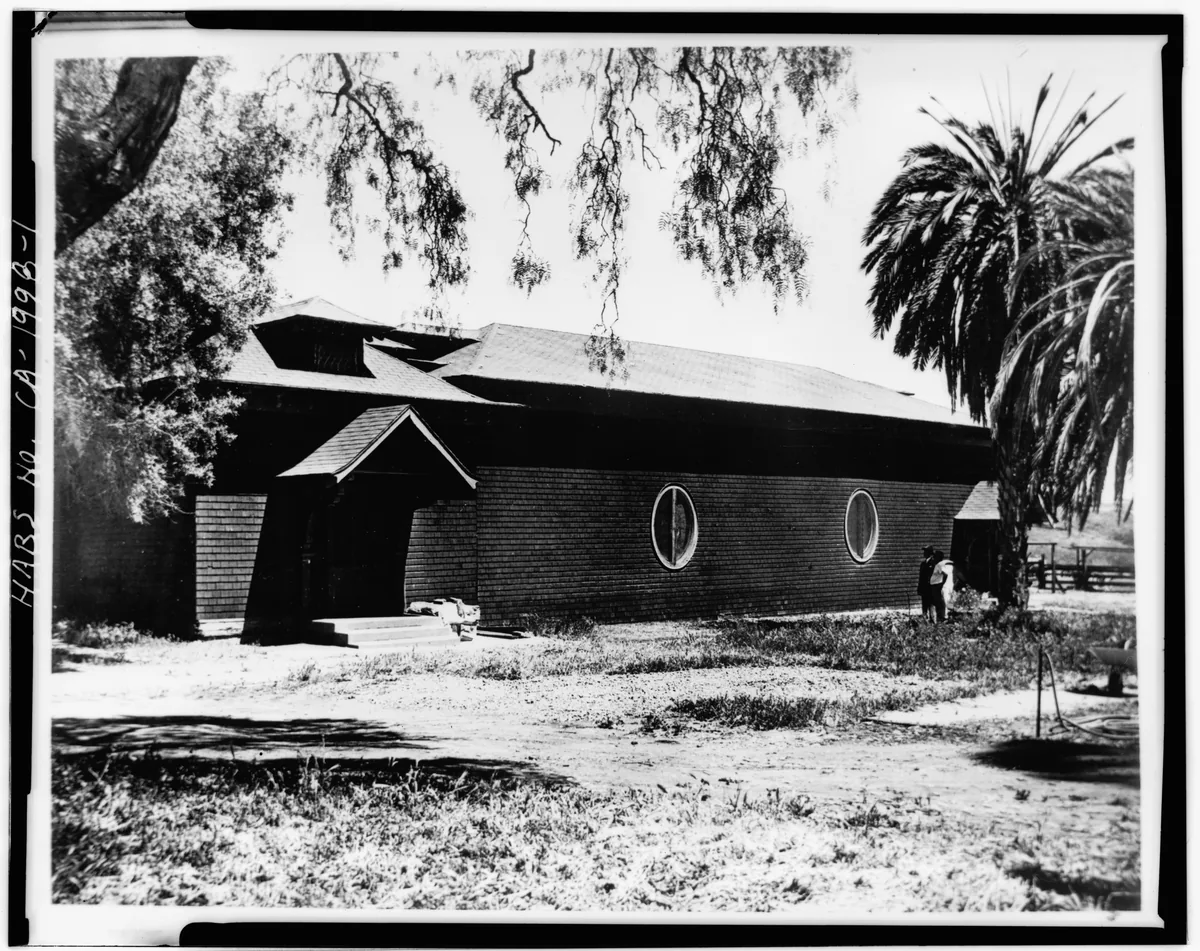
Archival HABS exterior photograph of Granger Music Hall in National City, California, with the entrance at left; photograph date unknown. Not a current view. Historic American Buildings Survey / Library of Congress, HABS CAL,37-NATC,2-1.
Photo: Unknown photographer; Historic American Buildings Survey (HABS) / Public domain (US) · Photograph date: Unknown01Documented history
Intro
A small redwood concert hall where some of the world's great violinists once played sits boarded up behind a fence on East 4th Street. It is one of the rarest surviving works of architect Irving J. Gill, and it has been silent since 2008.
History
Colorado silver magnate Ralph Granger had the hall built in 1898 at his National City estate, to a design by the young Irving J. Gill. It housed his violin collection and hosted private concerts. Granger later expanded it into an 80-by-30-foot auditorium with a 75-foot ceiling mural of Euterpe, the muse of music, and a Murray Harris pipe organ behind a carved cedar screen. Pianist Mark Hambourg, violinist Alexander Petschnikoff and Eugène Ysaÿe performed there. The Granger estate burned in 1906. In 1969 the land was sold for apartments, and the National City Historical Society moved the hall in two sections to East 4th Street, on City land leased for $1 a year. The hall was listed on the National Register of Historic Places in 1975.
Closure
After 39 years of weddings, quinceañeras and community events, the hall closed in 2008 when roof repairs were needed. A City plan to buy it for $10 and move it to the Port never went ahead, and the hall has stayed closed since (NCHS).
Current status (verified 2026)
SOHO's 2026 Most Endangered list describes it as "vacant, boarded up, fenced off, and deteriorating." SOHO inspected it and prepared a condition assessment in 2025. NCHS is petitioning the City for a lease to restore it in place.
02Historical notes
03Visiting
04Sources
Cited references · source websites are identified below.
Source notes: Accounts differ on how much the hall was used between 1906 and 1969. SOHO says it fell into disuse, while NCHS says private recitals continued for decades. The street number also differs (1615 vs 1700 E 4th St).
- SOHO, Most Endangered 2026sohosandiego.org
- National City Historical Societynationalcityhistoricalsociety.com
- City of National City public records (Granger special-research file)nationalcityca.gov
Spot an error or have a better source? Email hello@darkcoordinates.com
On the map
East 4th Street, National City (street level; publicly documented landmark)
Image credits
Photograph 1
Unknown photographer; Historic American Buildings Survey (HABS) · Public domain (US) · Full-frame responsive WebP encoding and resizing; aspect ratio retained, no upscaling or AI alteration; EXIF/GPS removed.
Source: https://www.loc.gov/pictures/item/ca0573.photos.015117p
Author: Unknown photographer; Historic American Buildings Survey (HABS)
License information: Public domain in the United States (PD-US-NPS; official-duty federal government work)
Caption: Archival HABS exterior photograph of Granger Music Hall in National City, California, with the entrance at left; photograph date unknown. Not a current view. Historic American Buildings Survey / Library of Congress, HABS CAL,37-NATC,2-1.
Photograph date: Unknown